



The retirement planning conversation you may not have had yet — but probably should.
The conventional framework for retirement portfolios has remained largely unchanged for a generation: stocks provide growth, bonds provide stability, cash provides liquidity. It’s tidy, it’s teachable, and during the decades when you were building wealth, it worked reasonably well.
But building wealth and living off it are very different problems.
As you approach or begin retirement, the portfolio question changes fundamentally. You no longer need assets that simply grow — you need assets that function. That means predictable income through all market cycles, meaningful protection against the kind of losses that can’t be recovered from at this stage, and a structure that doesn’t require favorable conditions to hold together. The traditional model was never fully designed to deliver on those needs. And recent market history has made the gap harder to ignore.
The question isn’t whether stocks and bonds still belong in your portfolio. They do. The question is whether they’re sufficient — and whether the framework itself needs to be expanded.
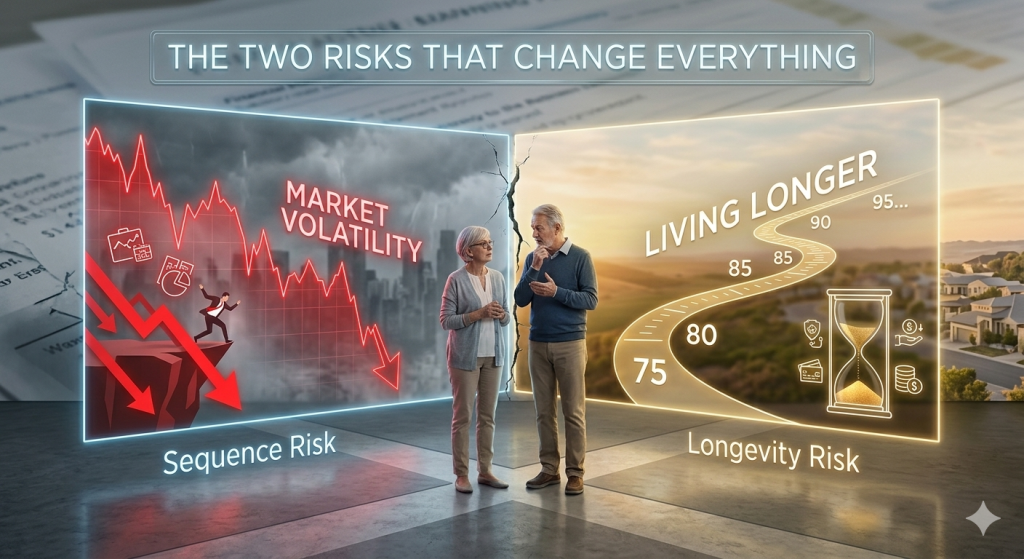
The Two Risks That Change Everything in Retirement
Most investment conversations center on the risk of earning poor returns. In retirement, two different risks become far more consequential — and neither is fully addressed by traditional asset allocation.
The first is sequence-of-returns risk. The order in which returns occur matters enormously once you begin drawing income from your portfolio. A significant market decline early in retirement — while you are actively withdrawing — can permanently impair a portfolio’s ability to recover, even if long-term average returns look similar to a more favorable scenario. The math is straightforward and unforgiving: losses early compound against you, withdrawals prevent full recovery, and the gap widens over time.
The second is longevity risk — the possibility of outliving your assets. With life expectancies continuing to extend and defined-benefit pensions largely absent from private-sector retirement, this risk now sits almost entirely with you as an individual. A 30-year retirement horizon is not unusual. A portfolio architected for 15 years is not the same thing, even if it looks similar on paper today.
What makes these risks particularly difficult to manage within a traditional portfolio is that the conventional hedge — bonds — has become less reliable as a counterweight. As 2022 illustrated plainly, bonds can decline alongside equities in certain environments, removing the cushion they were always assumed to provide. The negative correlation between stocks and bonds that underpinned the 60/40 model for a generation is conditional, not guaranteed. It holds under some conditions and fails under others — often the very conditions that matter most.
A Different Way to Think About Your Portfolio
Here is the idea worth considering:
Protection is not just a feature of certain financial products. It can function as a distinct, intentional allocation within your retirement portfolio — with a specific job to do that neither stocks nor bonds fully perform.
When strategies designed to define or limit downside exposure are incorporated alongside traditional growth assets, the overall portfolio may behave more consistently under stress. Not because these strategies generate superior returns in isolation, but because of a straightforward arithmetic reality: a portfolio that avoids a 30% drawdown doesn’t need a 43% gain just to break even. That asymmetry — limiting the severity of losses while preserving meaningful participation in recoveries — is exactly what a protection allocation is designed to provide.
This is a structural conversation, not a product conversation. The question isn’t whether a specific annuity or buffer strategy is right for your situation — that comes later. The more foundational question is whether your portfolio is deliberately architected to include protection as a component, or whether it’s simply assumed that traditional diversification will be sufficient. Those are meaningfully different positions, and the difference matters most when markets are at their worst.
What’s Happened to Bonds
For decades, bonds have served two clear purposes in retirement portfolios: they generated income and they provided ballast to stocks. When equities fell, bonds typically held their value or rose — giving portfolios a psychological anchor and a practical cushion.
That dynamic has become less dependable.
In rising rate environments, longer-duration bonds face real mark-to-market losses — losses that show up in your portfolio statements alongside equity declines, rather than offsetting them. Yields that once justified meaningful allocations to fixed income have been compressed for extended periods. And as noted above, the stock-bond correlation that modern portfolio theory relied upon has proven to be a historical tendency, not a structural guarantee.
None of this means bonds no longer belong in a retirement portfolio. For many investors, they remain an important component of an asset allocation. But it does mean their role deserves honest examination. For some, certain protected strategies may serve alongside or partially in place of traditional fixed income — not because they replicate what bonds do, but because they may offer a different path to what bonds were always meant to provide: a measure of capital preservation, a return profile distinct from equities, and a degree of stability that doesn’t depend on interest rate conditions moving in a favorable direction.
Diversification across risk structures — not just across asset classes — is often a more complete framework for the retirement stage of life.

Retirement Is an Income Problem, Not a Portfolio Problem
Here is an important detail that often gets lost in portfolio planning conversations:
Solving for retirement is not, at its core, an investment optimization problem. It is an income engineering problem. The goal is not to maximize a portfolio value for end of life— it is to sustain your standard of living, with high reliability, across an uncertain time horizon, while managing competing priorities like healthcare costs, legacy intentions, and liquidity needs.
When protection is incorporated at the income level — not just the portfolio level — something qualitatively different happens. A portion of your spending becomes predictable, no longer contingent on what markets are doing in a given year. The assets that remain invested can be managed with greater flexibility and focus on growth, because they no longer carry the full burden of your monthly income needs. And you are far less likely to make the kind of reactive, fear-driven decisions — like selling at lows, or abandoning a disciplined strategy — which can destroy more retirement wealth than almost any other single factor.
Research by retirement income specialists — including David Blanchett and Wade Pfau, among others — consistently finds that incorporating protected income sources improves the probability of meeting lifetime spending goals while also better preserving assets over time. The mechanism is not complicated: certainty in one part of the plan creates freedom and flexibility everywhere else.
Two Roles, One Coherent Plan
It helps to think about protection serving two distinct but connected roles in your retirement:
In your portfolio, an allocation including protection can help manage drawdown risk, mitigate the impact of sequence-of-returns, and may improve risk-adjusted outcomes over a full market cycle. It doesn’t replace growth—it helps make the growth you’re pursuing more sustainable.
In your income plan, protection provides a foundation. When a portion of your income is secured independently of market performance, the rest of your plan — how remaining assets are invested, how you navigate market volatility, how you think about legacy planning — can be approached with greater confidence and flexibility.
Together, these roles describe a structure that is genuinely aligned to the phase of life it’s meant to serve: retirement. Not accumulation extended indefinitely under a different label, but a deliberate architecture built around the realities of distribution, longevity, and the income your life actually requires.
The Conversation Worth Having
If you’ve arrived at or near retirement with a portfolio that — by conventional measures — looks solid, that’s genuinely good news. But it raises a question worth examining carefully: how does your portfolio actually function as an income source across 25 or 30 years, under all market conditions, not just the favorable ones?
That question doesn’t have an obvious answer from your portfolio statement alone. It requires looking at asset structure, not just size — at how the pieces interact under stress, and how effectively your strategy balances your particular income needs with long-term growth.
If you haven’t had that conversation yet, it’s worth having now—before the timing of early market returns begins to shape outcomes in ways that are hard to reverse.
A Starting Point
The Retirement Clarity Check is a conversation designed to surface exactly these questions for your specific situation. This is a structural assessment – not a product recommendation. An honest look at whether your current plan is built for the demands of the phase you’re entering, or whether it’s still optimized for a phase you’ve left behind.
If that’s a discussion you’re ready to have, we’re ready to have it with you.
Bibliography:
Blanchett, David, and Michael Finke. 2024. “Guaranteed Income: A License to Spend.” Working Paper. Retirement Income Institute, Alliance for Lifetime Income. Available at: protectedincome.org (Supports: the finding that retirees with annuitized income spend roughly twice as much as those with equivalent non-annuitized savings; the behavioral license-to-spend mechanism)
Blanchett, David, and Michael Finke. 2025. “Retirees Spend Lifetime Income, Not Savings.” Financial Planning Review, vol. 8, no. 3: e70010. DOI: 10.1002/cfp2.70010 Also available via SSRN: ssrn.com/abstract=5076626 (Supports: the finding that approximately 80% of lifetime income is consumed vs. roughly half of non-annuitized savings; converting savings to lifetime income improves retirement consumption)
Kitces, Michael E. “Understanding Sequence of Return Risk & Safe Withdrawal Rates.” Nerd’s Eye View / Kitces.com. Available at: kitces.com (Supports: the mechanics and consequences of sequence-of-returns risk in retirement)
Pfau, Wade D., and Michael E. Kitces. 2014. “Reducing Retirement Risk with a Rising Equity Glide-Path.” Journal of Financial Planning, vol. 27, no. 1: 38–45. Available via SSRN: ssrn.com/abstract=2324930 (Supports: Kitces’ broader research on retirement income sustainability and sequence risk management)
Vanguard. “Understanding the Dynamics of Stock/Bond Correlations.” Vanguard UK Professional. Available at: vanguard.co.uk (Supports: 2022 being the first year both equities and bonds posted negative returns since 1977)
State Street Investment Management. October 2025. “Mind on the Market: 60/40 Strategy Regains Strength.” Available at: ssga.com (Supports: equities and bonds declining simultaneously for 14 consecutive months beginning early 2022)
J.P. Morgan Private Bank. 2024. “Bonds May Play a Renewed Role in Portfolios — Are You Ready?” Available at: privatebank.jpmorgan.com (Supports: historical context on stock-bond correlation; negative correlation persisted only 38% of the time since 1940)
Last updated 4/6/2026